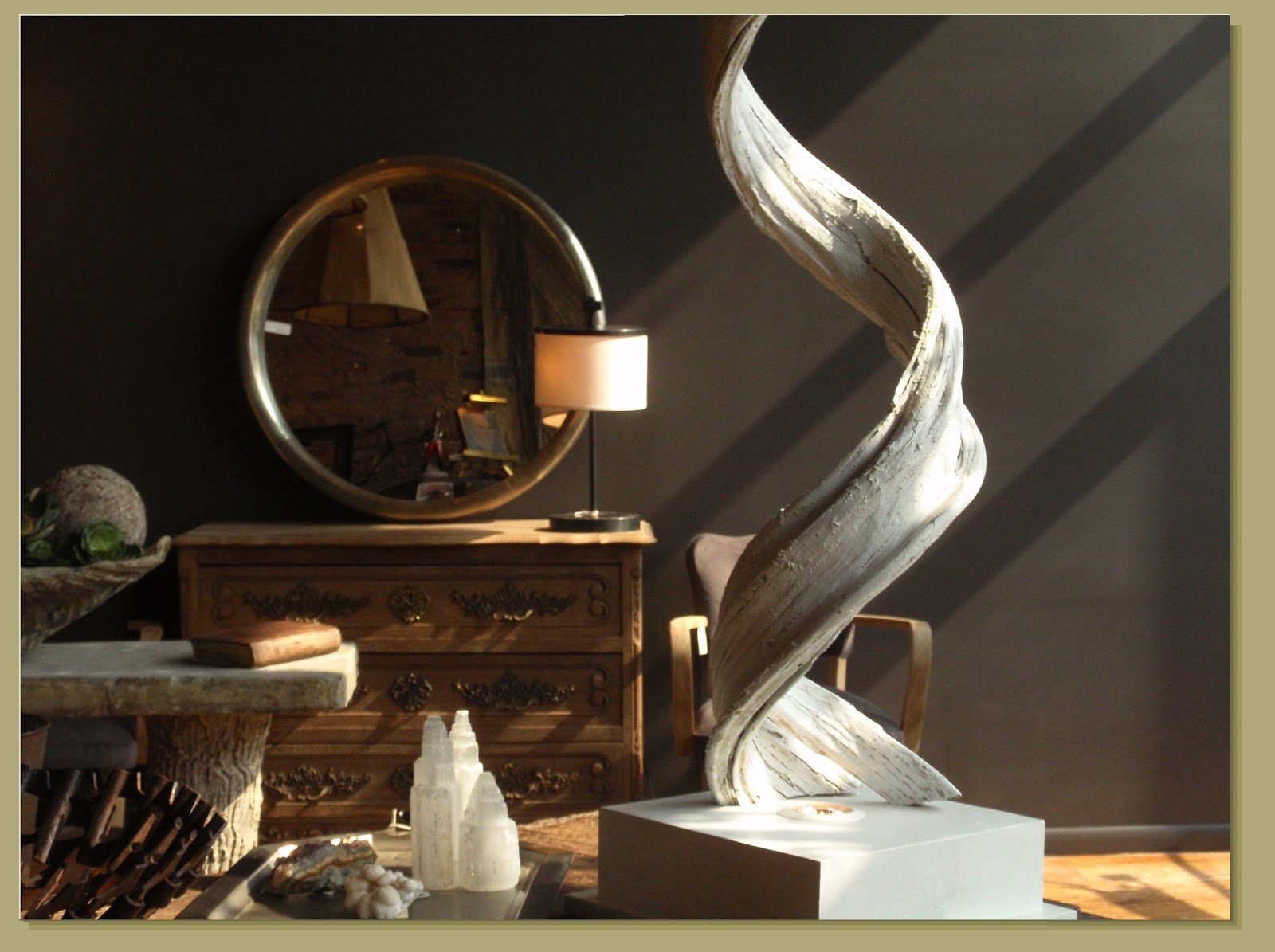
Actually, although I did take the photo above right here on Grand Avenue, it's not a sunset: it's a rusty car fender I spotted on the next block, and its not even a very good photo, because when the woman idling at the curb realized I was getting ready to take a picture of her vehicle--and of course, she had no idea why I was doing it--she took off. The friend I was walking with to pick up a pizza down the block didn't blame her. What can I say? All he saw was a beater car with a noisy muffler junking up the neighborhood, but I saw the kind of expansive Midwestern sunset you see if you driving west on I-80. Beauty is everywhere if you just keep your eyes open.
Speaking of the neighborhood, though--and sunsets--we're outta here. Debra Phillips, the owner of SG Grand, will be relocating her Chicago shop to new quarters, although, at this point, I can't yet say to where, or when it will open its new doors. Ideally, its new location will have all the things that we liked about the spot we occupied for the last three years--that is, friendly neighbors with cool & distinctive shops, proximity to downtown, and a space that's cool all by itself, although, if I were the one making up the list of things to look for in a potential new location, I might add a street that has some trees, to encourage more foot traffic, or, for that matter, any. This is a neighborhood people drive to, buy a bunch of stuff--that's the plan, anyway--and then get in their car and leave. On a framed vintage map of Chicago neighborhoods that's for sale at The Find across the street from the shop, this area doesn't even have a name. All around us are ranged the colorful shapes of named neighborhoods with colorful histories, and right in the middle of all that, there's an unnamed stretch that's the same color as the paper the map's printed on. That would be us. Let's face it: no one strolls down Grand Avenue. No one ever has.

The lack of foot traffic isn't hard to figure out. It's due to the street's narrow sidewalks, the consequent absence of any trees to cut the relentless summer glare, and the fact that the traffic engineers have timed the signals so that, if you take off like a jackrabbit at the Wood Street signal to our east and then speed past--at forty miles an hour--you can make the green light at Damen, two blocks west. Just barely. That speed-&-hot-wind factor pretty well kills any hope of this ever being a pedestrian-friendly strip, and for the folks zooming past in their air-conditioned cars, well there's not much time for checking out what's in the windows of the shops along the block, or, for that matter, even noticing that there are any shops. So maybe SG Grand's new location will have some trees--and not be located on a truck route. At any rate, the hunt for a new spot goes on.

Not that the sidewalks in our neighborhood are any more pedestrian-friendly in the winter
Meanwhile, though, our neighbor Julia Edelmann of Buckingham Interiors (and of a slew of trendy design magazines these last few years) is getting ready to be expand her design studio into our former space, so, after winding down the shop's moving sale, I spent another week sorting through random leftovers, arranging with customers for pickups of sold merchandise that was still here and sweeping up street grit & brick dust, of which there was a lot.

Here's the thing: exposed brick looks great in photos, but it's messy, especially when you have big trucks rumbling past your door all day long, turning ancient mortar back into sand. But once I finished sweeping out the grit, cutting up the boxes, hauling out the trash and scrubbing the cabinets, I finally had a chance to sit down--on the floor, of course, every last stick of furniture having either been sold, or taken out to Scentimental Gardens, Debra's main shop out in Geneva, or put into temporary storage until she finds the right spot for the shop's new location--and eat some dinner from the pizza joint down the block. Well, time to eat, that is, and to think back over these last three years, since I won't be making the move to the new quarters, wherever they might turn out to be.

Back in 2010, when Debra asked me if I wanted to work for her, I had only met her once before--at a party--but I'd read 5thandState--her own blog--and she had read a bunch of my comments on various decorating message boards, and later, on other people's design blogs, which comments I'd made under the nom de web Magnaverde, which name, at that point, I had already been using for more than a decade. Debra & I had also been emailing back & forth for while, so she knew that I had a design degree, and she had seen the spread on my apartment when it was published in the next-to-last issue of O at Home, so she already knew I had a pretty deep background in design & decorating, especially anything having to do with historic interiors. But she also knew I had never worked in a retail setting before, so

when she hired me, Debra made a huge leap of faith. Then again, she's said on her blog more than once that her motto is "Jump and the net will appear" and, as I learned not long after I started working in the shop, her reference to 'jumping' was not merely metaphorical.

Right from the start, I liked the things that she had in the shop--pieces she had found at the kind of discreet sales that never make it into any sort of public notice, or on her trips to England & France, or on her twice-a year expeditions to Atlanta & Nashville--but what bothered me was that customers more-or-less had to infer the personality that lay behind the choice of all the pieces in the shop: they had to connect the dots themselves. And because Debra was seldom in Chicago, it was tough for a lot of people--Chicago people, that is, who had never been to her shop in Geneva ("Are you talking about Lake Geneva?" new customers would invariably ask)--to get any real sense of Debra's personality, which awareness, I felt, was important to the shop, so that we weren't just a collection of stuff. I decided to try to fix that.
I wanted to make her name part of the shop's title--preferably, "Debra Phillips' SG GRAND", with her name above the title--but although she had given me a lot of leeway, she didn't tell me I could scrap the existing graphics and start over, so I decided to start out small. One of

the first things we did after I arrived in January 2011 was to have an art opening. The shop had had a really big December and all those sales had left the place looking a bit thin, so Debra was getting ready to go to England to restock, but it was going to be a long time before the new stuff arrived, so before she left, I convinced her to go with me to my friend Sam Rosenthal's studio to check out his amazing paintings. I already owned a small painting of his that I'd bought down at the Union League Club a few years before, but Sam's work had two major factors in its favor, as far as showing it in the shop went: it was really good, and some of it was really, really big: his largest pieces would cover up a lot of empty real estate until Debra got back. Fortunately, when she saw Sam's work in his studio,

Debra liked it just as much as I did, so we picked out a dozen or so paintings and made arrangements for them to arrive at the shop after I had a few days to paint our off-white walls dark gray to better serve as a foil for the art. Sam's biggest painting was spectacular--an empty Chicago intersection, late at night, in a snow shower--and at twelve feet wide, it took up the entire wall behind my desk. Another painting was eight feet tall.
Unfortunately, by the time the show opened, Debra had already left for London, so I decided that, in her absence, we should at least have a few photos of her scattered around the shop, so that the people who had never met her would understand that the woman behind everything they saw was an actual person--like Martha Stewart or Ralph Lauren--not a made-up figure like Betty Crocker. And, sure, Ralph Lauren may not be his given name, but he's a real guy, and it's his taste that dictates the look of his stores, so I wanted pictures of Debra in her shop. Here and there, we already had some handsome antique silver frames and a few more from the 1930s, made from birch bark, so I called Debra's husband Steve to see if he could find some cool photos of her, and he showed up with a whole envelope of them, which I then made laser copies of and framed. And here's where that part about Deb's motto regarding 'jumping' comes in.
Now I'm not exactly sure what it was I had in mind, but I did know that Debra's house was a rambling, much-added-onto 19th century farmhouse that sat in the middle of an English-style garden in the valley of the Fox River, for much of its length, a most English-like flat sheet of water that takes a leisurely, meandering path through the countryside, and I guess I was expecting maybe some photos with that sort of calm, bucolic feel--say, Debra in a broad-brimmed garden hat (the classic shot of Lady Diana Cooper feeding her chickens was in the back of my mind) or, maybe, one of her raking leaves in a patched & tattered Filson jacket.

But, no. Instead of those, I got a 1980s photo of her making a silly face, wearing a sort of casual, pinned-up hairstyle that fell midway between Cyndi Lauper & Ivana Trump, and sitting, as I recall, on a plump, rolled-arm sofa, covered, in true 1980s style, in--what else?--a classic English-style floral chintz that Mario would have heartily approved. It was a great shot, just the kind of thing I wanted, and with the hair and the grin, you instantly got an idea of Debra's sense of fun, but, even so, that shot paled in comparison to another photo in the pile: Debra with a short, wavy haircut and wearing a white canvas jump suit, with a helmet in hand, and bent over as she's getting ready to...jump out of an airplane? WTH? All I knew is that it was ten-to-one that Martha didn't have a snapshot like that.
Best of all, with those photos (and a few others that I had placed around the shop in strategic spots where they were hard to miss) people at the opening night party for Sam's paintings really got a glimpse of the woman's wide interests, especially since they when they could also look around the shop and see all the different kind of things that appealed to her broad tastes. Few of the guests that night had ever met Debra but everybody loved seeing her photos, which fact I know because I made it a point to talk to everybody.
OK, let me clarify that a little. Everybody loved seeing Debra's photos except Debra. When she came back from London, jetlagged, she stopped into the shop on her way home from the airport so she could see how the place looked in its new paint job and with Sam's art on the walls. "Oh, I love it! I absolutely love it!" she said as she explored the reworked traffic paths. Then I heard a sudden, sharp intake of breath and the sound of my name taken in vain. "Oh, Bart!" I cringed. I was imagining that someone had busted a lamp, or spilled something on a white linen sofa and that, somehow, the damage had escaped my notice, but it wasn't that. No, she came around the display rack of candles waving around the silver-framed photo of her in her jump suit. "WHERE did you GET this?" I swallowed hard and tried to move behind the desk before I answered, but it was too late: before I could even open my mouth, she had glanced over and spotted the Cyndi Lauper shot, too. "Oh my god! How many are there of these? Where did you get them?" Now she had a picture in each hand, waving them around like a crazy woman. Naturally, I took self-defensive measures. That is, I deflected blame from myself by throwing her husband under the bus. "Ummmm...Steve gave them to me?" and then I added--in an undertone--"I asked him to." She took another big breath, gave me a laser-beam look and announced "I am going to kill Steve Phillips!" Oh-oh, I thought: This is a really bad sign: we're in last-name territory. Thus went my fourth--and most memorable--meeting with Debra.
Things have calmed down since that time. Steve is, fortunately, still among the living and I have to say he has been a great help, always doing anything that I ask him to do, many of which tasks revolve around the fact that he's about a foot taller than I am. Anyway, all that blew over and now Debra and I are not just boss & [former] employee, we're friends, and, in all my tine at SG Grand over the last few years, I only have a few regrets. One is that it wasn't until a few weeks ago that I finally saw her house in person. And it turns out I wasn't told the half of it. I've been trying to insinuate myself into other people's houses for a look-see for half a century, now--and, believe me, it was a lot easier as a cute, precocious twelve-year-old than it is for me today--but although I've seen bigger houses, older houses, more expensive houses--and, yes, more beautiful houses--I've never--never--been in a house that exudes the feeling of welcome that Debra's house does. And the most remarkable part about it is that I can't really remember many details about it. Sure, there were chairs & tables in the right places, and cupboards in odd places filled with old transferware, and small-paned windows, and floor levels & ceiling heights that seemed to change every time you moved between rooms, but as far as the actual contents of the rooms went, nothing stood out. There were no obvious 'focal points', there was no 'wow factor' nonsense. In fact, if there were any 'pops of color' at all, they must have been muffled enough for me not to notice them, so that they all blended together into the overall effect of calm and comfort. And I told her that. The whole thing was the very best demonstration I've ever seen of something the great Nancy Lancaster once said: "You never wanted to have only one mouvement thing like the Savonnaire rug that would stand out. You must have mouvement everywhere."
My only other regret--and this one is looking forward, not back--is that with the move, I won't be here, running the shop this fall, because I have two blog friends who, in the coming weeks, are coming out with books that I would have loved to host a signing for here in the shop. My friend Emily Evans Eerdmans has written the book that I (and a lot of other people besides) have been waiting for for years: the first full-length book on MARIO BUATTA. And that's not the only good news. Jennifer Boles, of The Peak of Chic blog is coming out with what looks to be an excellent book of her own: IN WITH THE OLD: CLASSIC DECOR FROM A TO Z. Sadly, you won't be able to meet either of those two here in the shop sitting, pen in hand, behind a stack of glossy books while the rest of us all drink Champagne, the way I was hoping things might work out, but you can, at least, preorder both books via the links above with the books' green ALL-CAPS titles, and then have a glass of Champagne at home. It's not quite the same as all of us sitting here in the shop laughing and boozing up a storm while Emily & Jennifer sign books, but, hey, it will have to do. Besides, just knowing that you're doing your part to support America's independent booksellers will make the Champagne extra fizzy. Cheers!
Anyway, now that it's over, I can say this: my time here at SG Grand has been thoroughly enjoyable. Debra and Steve have been wonderful to work for, Amanda, my weekend assistant, was a delight, so much so that, half the time, the only reason I stopped in on a day when I was allegedly "off" was to see her and find out what she'd been up to during the week. I know that our customers will miss her as much as I will. And I'll miss a lot of them, too. Not all of them, of course. Let's face it: supercilious know-it-alls are drawn to antique shops like bees to park trash cans, but that crowd is way outnumbered by genuinely nice people, and I've discovered that the nicer you are to people, the nicer they get. I hope that I'll still see--somewhere--Marilyn, Sue, Mary Ann, Amy, Winnie, Sharon, Julie, Summer, Rita, Rochelle from Bring it Home, Kathleen, Colette, Sandy, Marguerite, Shirl, Kirk, Brad, Tom, Jim, Brian, Jason, Justin, Mark & Chaz, as well as Robbie and his family, John and his charming, smart kids, and TJ, who only stopped in twice, but who made an indelible impression while he was here. I'll also miss all the clever dogs that had successfully trained their owners to stop into SG Grand for a treat, and often, since they were here anyway, to buy a candle as a treat for themselves. Good dog!

Me, I'm not yet sure where the next stop on my itinerary will be, but even though SG Grand and I are history, I'll be leaving this blog up, as a sort of digital memento of my time in the shop. However, this is it: after today, there won't be any new posts here--not, I'm sorry to say, that I ever made very many in the first place. And from here on, when I post on other people's blogs (and you know I can't keep quiet for very long) I'll be going back to the original online name under which Debra first came to notice me--Magnaverde--although, even then, I won't be able to make any actual blog posts under that name until I can remember what my password is: the last time I logged in under that name was four years and two computers ago, so wish me luck on that. Either way, Simply Grand The Blog is now history, so for anyone who ever needs to get hold of me from here on out or who simply wants to keep in touch, don't look for me here. My address is the same as it's been since 1997: magnaverde-at-aol-dot- com.

Me, I'm not yet sure where the next stop on my itinerary will be, but even though SG Grand and I are history, I'll be leaving this blog up, as a sort of digital memento of my time in the shop. However, this is it: after today, there won't be any new posts here--not, I'm sorry to say, that I ever made very many in the first place. And from here on, when I post on other people's blogs (and you know I can't keep quiet for very long) I'll be going back to the original online name under which Debra first came to notice me--Magnaverde--although, even then, I won't be able to make any actual blog posts under that name until I can remember what my password is: the last time I logged in under that name was four years and two computers ago, so wish me luck on that. Either way, Simply Grand The Blog is now history, so for anyone who ever needs to get hold of me from here on out or who simply wants to keep in touch, don't look for me here. My address is the same as it's been since 1997: magnaverde-at-aol-dot- com.
Meanwhile, though, before I go, as a little souvenir album for anybody who ever visited the shop in person and who might like to remember it as it was (although there was never any statistically-significant overlap between this blog's readers & our customer base) or, more likely, as a little taste of what those who never actually made into the shop missed--and, too as an objective record of the things that came and went through our doors, since, often, what isn't documented might as well never have happened in the first place--here are a few pictures of what we looked like at one point or another, before it all went away.

Your host. It's been great, friends.
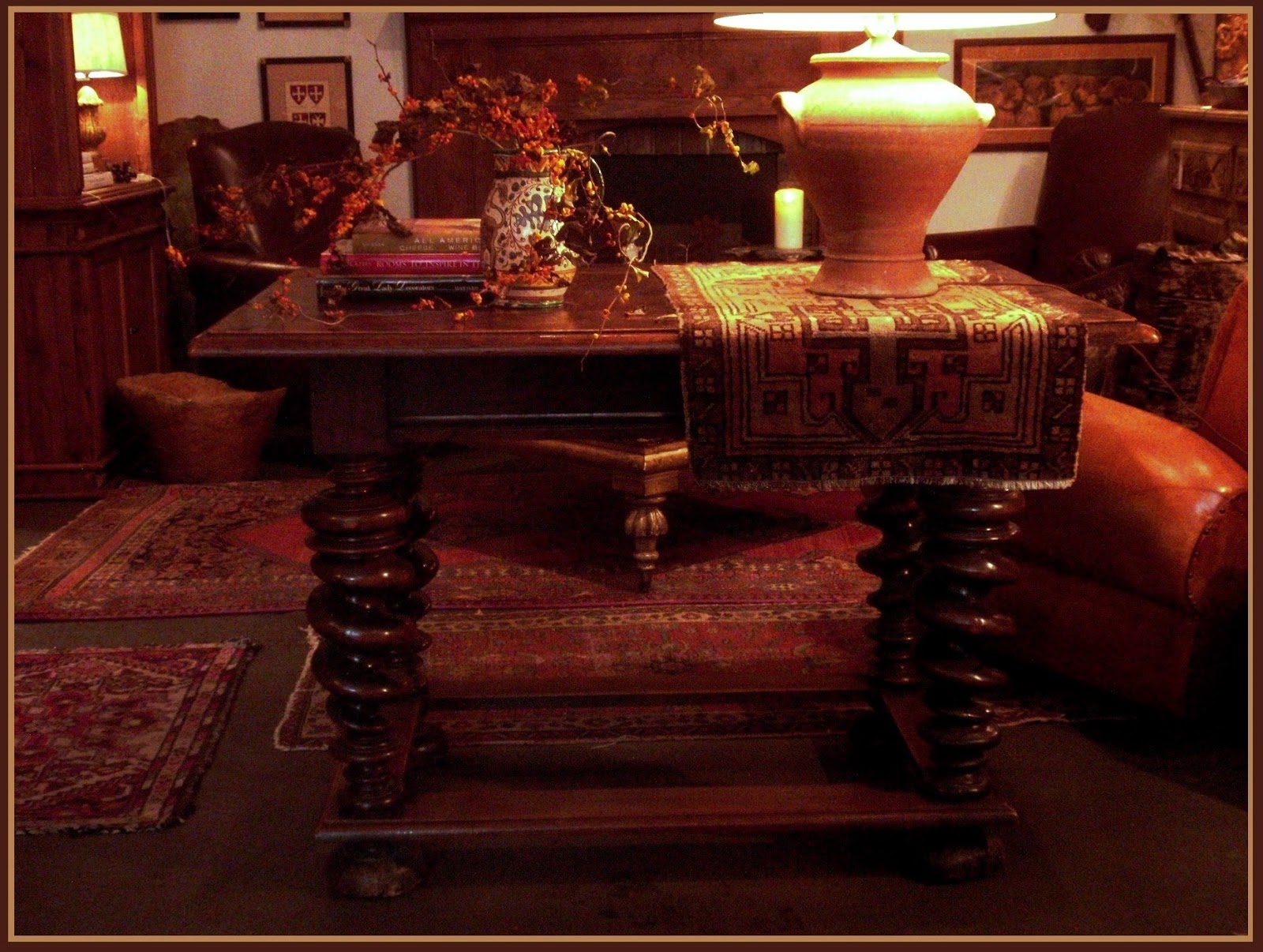
The coolest table we ever had in the shop: Portuguese Baroque

Roulette Cranes

Antinous & Narcissus.

December 2012: What would Dorothy Draper do?

The Castaing Corner, in honor of Emily's previous book

Am I Pretty? What can I say? It doesn't take much to amuse me

Light is the cheapest decoration of all--while it lasts.

Dead, shmead. We all have to go sometime.

The attic, where things orphaned from a more complete setting landed

These Directoire-style steel-&-brass daybeds sold the morning they hit the floor.


A chair from a Chairs for Charity auction, with a cushion by Tony Fitzpatrick.

Dead weeds are beautiful and they last forever, because, well, they're already dead.

Springfield Cabinet. I should have bought this when I had the chance.

End of the line: Late summer, 2013. I bought the sofa myself
--------------------------
And finally, I close my last post with deepest thanks to the woman who made it all possible.
To Debra! I've enjoyed every minute.